
When comparing quotes from three different hook factories for the exact same #4/0 saltwater hook, why can one quote be 35% cheaper? Almost always, the answer is hidden inside the raw steel wire coil. A hook formed from low-carbon 45# wire looks identical to a hook formed from 82B high-carbon steel (0.80%–0.85% C) after Black Nickel electroplating—until a 20 lb fish hits and bends the economy hook straight like a paperclip.
This metallurgical reference demystifies the five global wire standards used in modern hook manufacturing—72A, 82B, SAE 1080, Vanadium-microalloyed carbon steel, and AISI 304/316 stainless—so OEM buyers know exactly what they are paying for.
Section 011. Comparing the Five Industrial Fishing Hook Steel Wire Grades
In quenched-and-tempered carbon steel, carbon percentage governs maximum achievable martensitic hardness, while trace alloying elements like manganese (Mn) and vanadium (V) refine grain boundaries so heavy bends resist cracking.
| Steel Wire Grade | Carbon / Alloy Chemistry | Hardening Method | Best OEM Hook Applications |
|---|---|---|---|
| 72A (GB/T 4354) | 0.70–0.75% C · 0.60–0.90% Mn | Quench & temper | All-round freshwater/inshore trebles, jigs, EWG, beak |
| 82B / SAE 1080 | 0.80–0.85% C · High Mn | Quench & temper | 3X–4X offshore trebles (ST66), heavy circles, frog doubles |
| Vanadium High-Carbon | ~0.80% C + trace V (0.05–0.15%) | Quench & temper (fine grain) | Premium thin-wire high-strength lures & assist hooks |
| AISI 304 / 316 SS | 18% Cr / 10–14% Ni (+2–3% Mo in 316) | Cold work-hardening only | 72h+ commercial longline, tropical flats, trolling rigs |
Wire Alloy Performance Matrix: Yield Strength-to-Diameter Ratio Across Hook Steels
Relative tensile yield ceiling at identical wire diameter after optimal factory heat treatment / drawing
Section 022. Why High Carbon Alone Is Worthless Without Controlled Tempering
Raw 82B high-carbon wire straight out of an oil quench is rock-hard (~62–65 HRC) and completely unusable—it would shatter if dropped on a tile floor. The craft of hook metallurgy lies in the tempering stage: reheating quenched hooks in an atmosphere-controlled furnace to dial hardness precisely into the ductile-spring sweet spot (typically 46–52 HRC depending on wire gauge and pattern), locking maximum straightening resistance while guaranteeing smooth yielding instead of snapping.
Clamp a sample hook's bend in a bench vise and pull the eye with a digital luggage/UTM scale. Low-carbon economy hooks begin taking permanent bend set at 40%–55% of the load of genuine quenched 72A/82B steel and lack elastic spring-back.
| Performance Priority | Recommended Wire Grade | Target Hardness Window | Coating Pairing |
|---|---|---|---|
| Maximum Strength at Thin Wire | 82B / Vanadium High-Carbon | 48–52 HRC (fine grain) | Matte Stealth / Saltwater Tin |
| Best Cost-to-Performance All-Round | 72A High-Carbon Steel | 46–50 HRC (balanced) | Black Nickel / Bronze / Tin |
| Zero-Rust Continuous Seawater Soak | AISI 316 Marine Stainless | Cold-drawn spring temper | Passivated bare stainless |
| High-Volume Economy Bait Packs | 70# / 72A Standard Carbon | 45–48 HRC | Bronze / Gold / Black Nickel |
Section 033. KONA High-Carbon Forged Reference Models
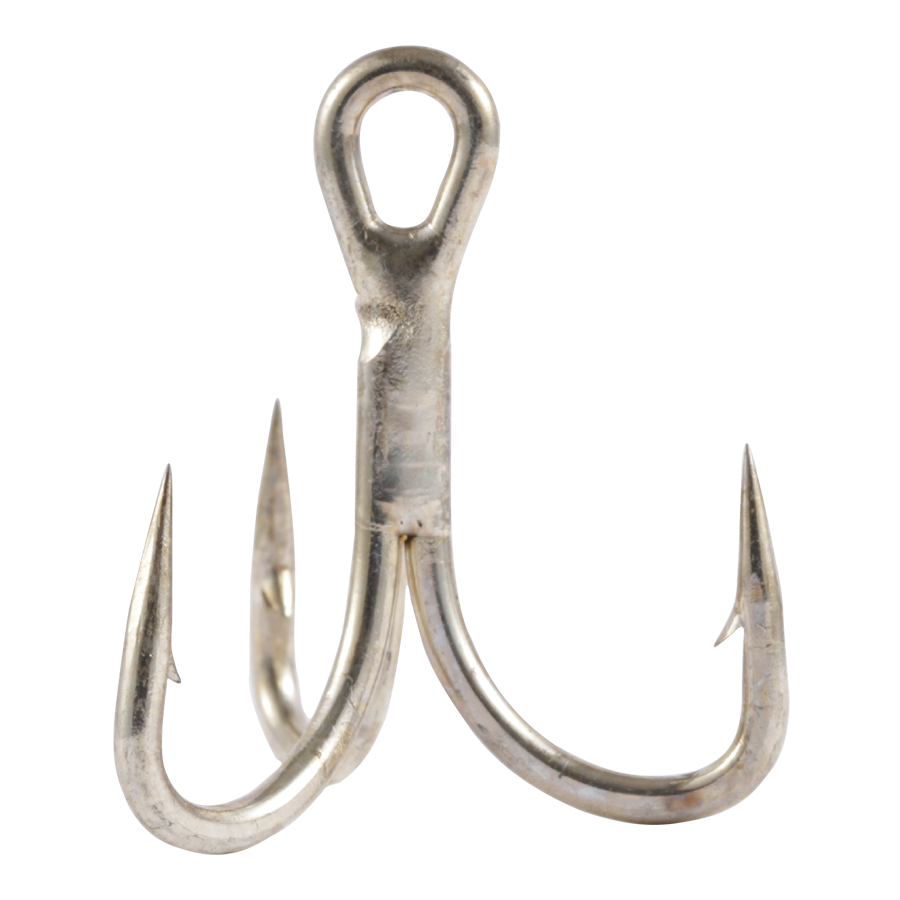
ST66 4X Strong Treble Hook
4X heavy forged high-carbon saltwater treble with uniform Tin/anti-rust weld coverage for poppers and jigs.
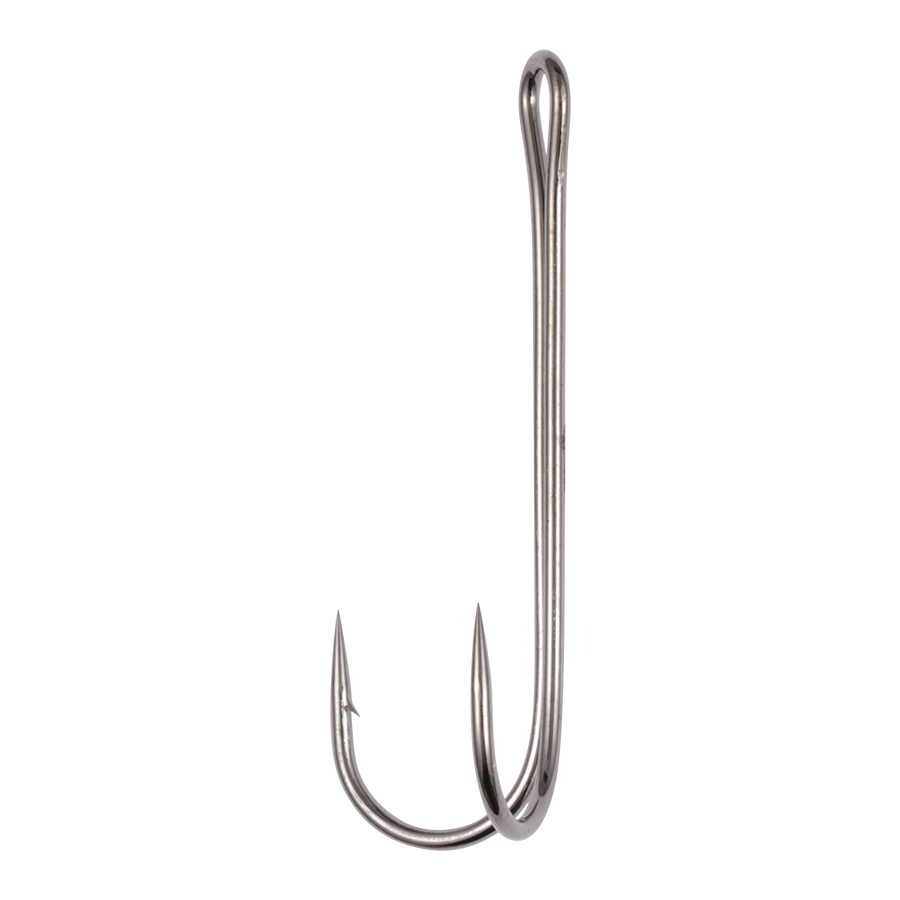
L14501 Forged Double Hook
Parallel-brazed high-carbon double hook engineered for hollow-body frogs, topwater poppers, and heavy cover.
Section 044. B2B Raw-Material Verification SOP for OEM Buyers
Buyer Q&AFrequently Asked Questions for OEM & Wholesale Buyers
What steel grade does JiangXi KONA use for standard and 4X-strong fishing hooks?
We primarily draw and form certified 72A and 82B high-carbon steel wire (equivalent to SAE 1070–1085) for quenched hooks, alongside AISI 304 and 316 stainless steel for marine longline and saltwater lines.
Is 82B steel always better than 72A steel for fishing hooks?
82B achieves higher ultimate tensile strength for heavy 3X–4X offshore and frog hooks, while 72A offers slightly higher ductility and cost efficiency for standard 1X–2X freshwater and bait hooks.
What does adding vanadium to high-carbon hook wire actually do?
Trace vanadium refines steel grain size during heat treatment, improving toughness and resistance to brittle fracture when drawing ultra-thin, high-strength wire.
Can KONA supply mill certificates or lab test reports for OEM contracts?
Yes. We provide batch traceability, UTM pull-force data, and ASTM B117 salt-spray reports for OEM accounts.
Technical Standards & Peer-Reviewed References
- ASM International. ASM Handbook, Volume 1: Properties and Selection — Irons, Steels, and High-Performance Alloys (SAE 1070–1085 & Vanadium Microalloys).
- GB/T 4354 / JIS G 3506: High-Carbon Steel Wire Rods (72A / 82B / SWRH72A / SWRH82B Equivalents).
Sourcing OEM Fishing Hooks for Your Brand?
Direct Nanchang factory (200+ specialists, in-house heat treatment & plating). Free stock samples & custom tooling quotes in 24h.