Preface: The Overlooked “Critical Link“
In the sport of fishing, we often get obsessed with expensive rods, smooth reels, or colorful lures. However, the only physical point of contact between you and the fish is that humble, unassuming piece of metal: the fish hook.
For Trout—a species known for being both cunning and sensitive—hook selection is absolutely decisive. Trout have a unique mouth structure featuring both hard bone plates and fragile membranes; they possess excellent eyesight and are wary of unnatural reflections; and their signature “death roll” when hooked is the ultimate test of a hook’s holding power.
This manual skips the obscure physics jargon to tell you intuitively: what hook to use in which scenario, and exactly why.
Chapter 1: Reading the Hook — Anatomy & Basics
Before diving into specific techniques, we need to reach a consensus. When you walk into a tackle shop and face a wall of hooks, you need to understand three core parameters: Size, Gauge (Thickness), and Shape.
1.1 The Confusing Size System
The hook sizing standard is one of the most counter-intuitive designs in fishing, and it’s where beginners often get tripped up.
-
“The Larger the Number, The Smaller the Hook”: This is the iron rule for freshwater hooks.
-
#18, #20, #22: These are micro hooks, the size of a grain of rice or sesame seed, mainly used in fly fishing to imitate tiny midges.
-
#10, #12, #14: These are the “Golden Sizes” for trout, roughly the size of a pinky fingernail.
-
#2, #4, #6: These are large hooks, used for big nightcrawlers or large lures.
-
-
“The Slash System (/0) is the Opposite”: Once you see “1/0″ or “2/0″, the rule flips—larger numbers mean larger hooks. However, for trout, unless you are targeting massive Steelhead or Lake Trout, you will rarely touch “/0″ class hooks.
1.2 The Mystery of Gauge: 1X Fine vs. 2X Strong
You will see terms like “1X Fine” or “2X Strong” on packages. This refers to the thickness of the wire.
-
1X Fine: The wire is one step thinner than a standard hook.
-
Pros: Light! Very light. Less damage to live bait, and allows dry flies to float on the water surface.
-
Cons: Soft. It might straighten out under the violent pull of a large fish.
-
-
2X Strong: The wire is two steps thicker than standard.
-
Pros: Hard! Very strong. It cuts through water to sink quickly and withstands heavy tearing.
-
Cons: Heavy, and requires more force to penetrate the fish’s mouth.
-
Chapter 2: Bait Fishing Combat Guide
This is the most common method, especially for stocked trout in lakes or family fishing trips. The core conflict in bait fishing is: We want the fish to eat securely (so we don’t lose it), but not too deeply (so we don’t kill it).
2.1 Strategy for PowerBait Dough
Berkley PowerBait is the ultimate weapon for stocked Rainbow Trout. You mold the dough around the hook.
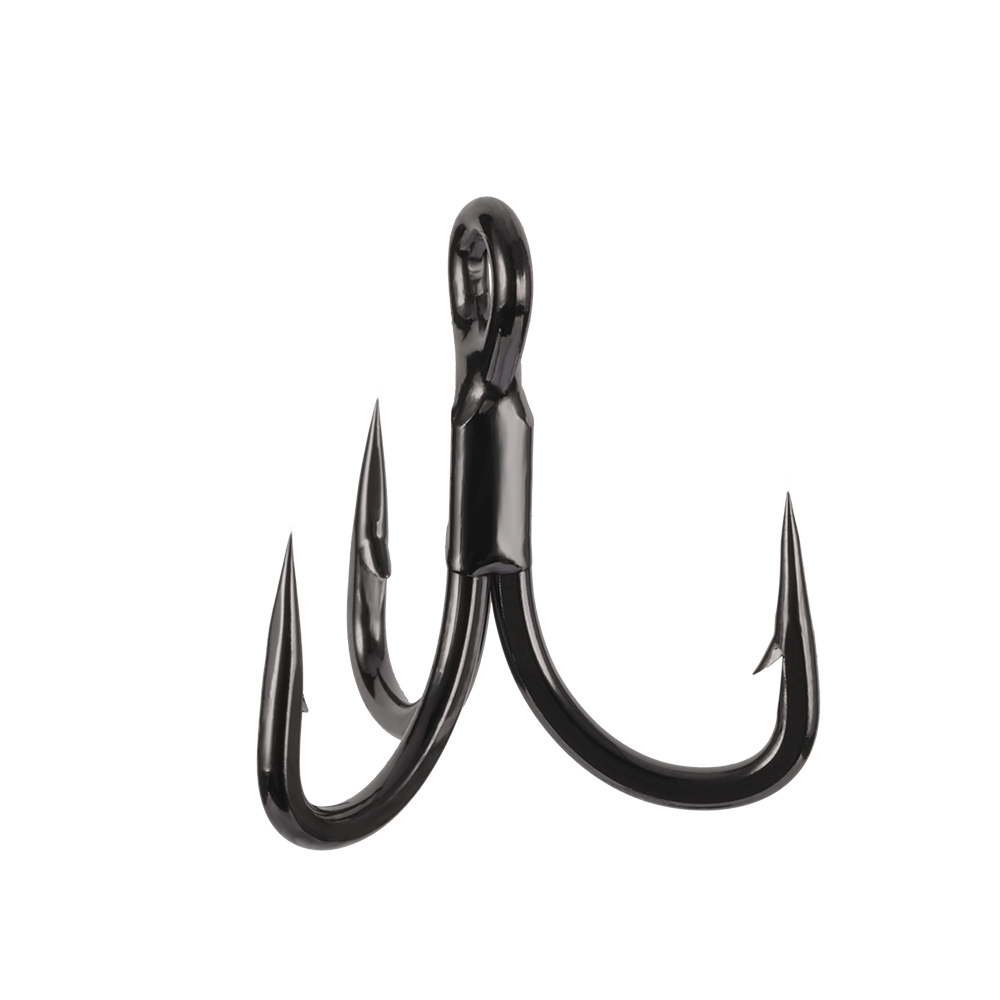
Plan A: Treble Hooks — The “Catch & Keep” Choice
If you are fishing for dinner, treble hooks are the most efficient tool.
-
Why choose it? The three prongs act like a claw to hold the dough firmly, preventing it from flying off during a cast.
-
Key Detail: You must choose a model with a Spring/Coil (Dough Bait Hook). The small spring acts as a skeleton to support the dough.
-
Size Recommendation: #14 to #18.
-
Rookie Mistake: Many use large #8 or #10 trebles. Do not do this! Trout have small mouths; large hooks are hard to hide, and exposed metal will spook the fish. A tiny #16 hook can be perfectly buried inside a pea-sized ball of dough, allowing the fish to swallow it without suspicion.
-
Plan B: Single Hooks — The “Catch & Release” Choice
If you want to enjoy the fight and release the fish, or are in waters where treble hooks are banned, single hooks are the only option.
-
Recommended Styles: Egg Hook or Octopus Hook.
-
Feature: These hooks have a Wide Gape, meaning a wide distance between the point and the shank.
-
Logic: When the dough dissolves or is crushed by the fish, the wide gape ensures there is enough space for the hook point to catch the fish’s mouth instead of being blocked by the dough.
-
-
Size Recommendation: #8 to #10. Note that single hooks should be larger than trebles here because you need that gap width.
2.2 The “Baitholder” for Worms & Live Bait
What is the biggest annoyance with fishing worms? It’s casting out only to have the worm ball up at the bend, blocking the point, or sliding off after a few pecks from small fish.
-
The Solution: Use a Baitholder Hook.
-
Core Design: Look closely at the back of the shank; there are two tiny barbs pointing upward. These aren’t for hooking the fish; they act like anchors to hold the worm’s flesh, keeping it extended and secure.
-
Size Recommendation:
-
Whole large Nightcrawler: Use #6.
-
Half worm or Red Wigglers: Use #8 or #10.
-
Chapter 3: Lure Fishing Advanced — Ditching the Trebles
When you buy a Minnow or Spoon, it usually comes with two treble hooks. The first thing modern lure experts do is—remove them and replace them with single hooks.
This isn’t just for conservation; it’s to stop losing fish. It sounds counter-intuitive: shouldn’t three points hold better than one?
3.1 The “Leverage Curse” of Treble Hooks
Imagine this scenario: A large trout bites one point of a treble hook. As it performs its signature thrashing jump (the “wash cycle”), the other two points exposed outside the mouth, along with the rigid lure body, become a lever. With a shake of the head, the centrifugal force of the lure uses this lever to pry the embedded hook point right out. This is the number one reason for losing trout on lures.
3.2 Single Hook Replacement: Siwash vs. Inline
After switching to a single hook, the hook connects via a flexible ring. No matter how the fish thrashes, the hook rotates with it, locking into the jaw without being pried loose.
However, you can’t just pick any hook. You must distinguish between two types:
Case 1: Your lure connects hooks via a “Split Ring”
-
Applicable Lures: Most Minnows (Plugs/Crankbaits), Spoons.
-
You Need: Inline Single Hook.
-
Feature: The eye is rotated 90 degrees (inline with the shank).
-
Reason: If you put a standard single hook on a split ring, the point will face sideways, increasing drag and missing bites. An Inline hook ensures the point faces perfectly up or down, aligned with the lure.
-
Case 2: Your hook is attached directly to a wire shaft
-
Applicable Lures: Spinners (e.g., Blue Fox, Panther Martin).
-
You Need: Siwash Hook (Open Eye).
-
Feature: The eye is open.
-
Operation: You cut off the factory treble, slip the open eye of the Siwash hook onto the wire loop, and then crimp the eye shut with pliers.
Preface: The Overlooked “Critical Link”
In the sport of fishing, we often get obsessed with expensive rods, smooth reels, or colorful lures. However, the only physical point of contact between you and the fish is that humble, unassuming piece of metal: the fish hook.
For Trout—a species known for being both cunning and sensitive—hook selection is absolutely decisive. Trout have a unique mouth structure featuring both hard bone plates and fragile membranes; they possess excellent eyesight and are wary of unnatural reflections; and their signature “death roll” when hooked is the ultimate test of a hook’s holding power.
This manual skips the obscure physics jargon to tell you intuitively: what hook to use in which scenario, and exactly why.
Chapter 1: Reading the Hook — Anatomy & Basics
Before diving into specific techniques, we need to reach a consensus. When you walk into a tackle shop and face a wall of hooks, you need to understand three core parameters: Size, Gauge (Thickness), and Shape.
1.1 The Confusing Size System
The hook sizing standard is one of the most counter-intuitive designs in fishing, and it’s where beginners often get tripped up.
-
“The Larger the Number, The Smaller the Hook”: This is the iron rule for freshwater hooks.
-
#18, #20, #22: These are micro hooks, the size of a grain of rice or sesame seed, mainly used in fly fishing to imitate tiny midges.
-
#10, #12, #14: These are the “Golden Sizes” for trout, roughly the size of a pinky fingernail.
-
#2, #4, #6: These are large hooks, used for big nightcrawlers or large lures.
-
-
“The Slash System (/0) is the Opposite”: Once you see “1/0″ or “2/0″, the rule flips—larger numbers mean larger hooks. However, for trout, unless you are targeting massive Steelhead or Lake Trout, you will rarely touch “/0″ class hooks.
1.2 The Mystery of Gauge: 1X Fine vs. 2X Strong
You will see terms like “1X Fine” or “2X Strong” on packages. This refers to the thickness of the wire.
-
1X Fine: The wire is one step thinner than a standard hook.
-
Pros: Light! Very light. Less damage to live bait, and allows dry flies to float on the water surface.
-
Cons: Soft. It might straighten out under the violent pull of a large fish.
-
-
2X Strong: The wire is two steps thicker than standard.
-
Pros: Hard! Very strong. It cuts through water to sink quickly and withstands heavy tearing.
-
Cons: Heavy, and requires more force to penetrate the fish’s mouth.
-
Chapter 2: Bait Fishing Combat Guide
This is the most common method, especially for stocked trout in lakes or family fishing trips. The core conflict in bait fishing is: We want the fish to eat securely (so we don’t lose it), but not too deeply (so we don’t kill it).
2.1 Strategy for PowerBait Dough
Berkley PowerBait is the ultimate weapon for stocked Rainbow Trout. You mold the dough around the hook.
Plan A: Treble Hooks — The “Catch & Keep” Choice
If you are fishing for dinner, treble hooks are the most efficient tool.
-
Why choose it? The three prongs act like a claw to hold the dough firmly, preventing it from flying off during a cast.
-
Key Detail: You must choose a model with a Spring/Coil (Dough Bait Hook). The small spring acts as a skeleton to support the dough.
-
Size Recommendation: #14 to #18.
-
Rookie Mistake: Many use large #8 or #10 trebles. Do not do this! Trout have small mouths; large hooks are hard to hide, and exposed metal will spook the fish. A tiny #16 hook can be perfectly buried inside a pea-sized ball of dough, allowing the fish to swallow it without suspicion.
-
Plan B: Single Hooks — The “Catch & Release” Choice
If you want to enjoy the fight and release the fish, or are in waters where treble hooks are banned, single hooks are the only option.
-
Recommended Styles: Egg Hook or Octopus Hook.
-
Feature: These hooks have a Wide Gape, meaning a wide distance between the point and the shank.
-
Logic: When the dough dissolves or is crushed by the fish, the wide gape ensures there is enough space for the hook point to catch the fish’s mouth instead of being blocked by the dough.
-
-
Size Recommendation: #8 to #10. Note that single hooks should be larger than trebles here because you need that gap width.
2.2 The “Baitholder” for Worms & Live Bait
What is the biggest annoyance with fishing worms? It’s casting out only to have the worm ball up at the bend, blocking the point, or sliding off after a few pecks from small fish.
-
The Solution: Use a Baitholder Hook.
-
Core Design: Look closely at the back of the shank; there are two tiny barbs pointing upward. These aren’t for hooking the fish; they act like anchors to hold the worm’s flesh, keeping it extended and secure.
-
Size Recommendation:
-
Whole large Nightcrawler: Use #6.
-
Half worm or Red Wigglers: Use #8 or #10.
-
Chapter 3: Lure Fishing Advanced — Ditching the Trebles
When you buy a Minnow or Spoon, it usually comes with two treble hooks. The first thing modern lure experts do is—remove them and replace them with single hooks.
This isn’t just for conservation; it’s to stop losing fish. It sounds counter-intuitive: shouldn’t three points hold better than one?
3.1 The “Leverage Curse” of Treble Hooks
Imagine this scenario: A large trout bites one point of a treble hook. As it performs its signature thrashing jump (the “wash cycle”), the other two points exposed outside the mouth, along with the rigid lure body, become a lever. With a shake of the head, the centrifugal force of the lure uses this lever to pry the embedded hook point right out. This is the number one reason for losing trout on lures.
3.2 Single Hook Replacement: Siwash vs. Inline
After switching to a single hook, the hook connects via a flexible ring. No matter how the fish thrashes, the hook rotates with it, locking into the jaw without being pried loose.
However, you can’t just pick any hook. You must distinguish between two types:
Case 1: Your lure connects hooks via a “Split Ring”
-
Applicable Lures: Most Minnows (Plugs/Crankbaits), Spoons.
-
You Need: Inline Single Hook.
-
Feature: The eye is rotated 90 degrees (inline with the shank).
-
Reason: If you put a standard single hook on a split ring, the point will face sideways, increasing drag and missing bites. An Inline hook ensures the point faces perfectly up or down, aligned with the lure.
-
Case 2: Your hook is attached directly to a wire shaft
-
Applicable Lures: Spinners (e.g., Blue Fox, Panther Martin).
-
You Need: Siwash Hook (Open Eye).
-
Feature: The eye is open.
-
Operation: You cut off the factory treble, slip the open eye of the Siwash hook onto the wire loop, and then crimp the eye shut with pliers.
-
-
-
Post time: Dec-11-2025